

How Much Caffeine in Turkish Coffee? (Actual mg Per Cup)
A single cup of Turkish coffee contains about 50–65 mg of caffeine — packed into just 2–2.4 oz (60–70 ml) of liquid. That makes it one of the most concentrated coffee drinks on the planet, delivering roughly 25–30 mg of caffeine per ounce.
When I first started brewing Turkish coffee at home, I assumed the tiny cup meant less caffeine. I was wrong. Ounce for ounce, Turkish coffee carries nearly double the caffeine of regular drip coffee. The ultra-fine grind, unfiltered brewing, and high coffee-to-water ratio squeeze serious caffeine out of a small amount of water.
This guide covers the exact caffeine numbers — per cup, per ounce, per 100ml, per gram, and per teaspoon. I’ve also compared Turkish coffee with espresso, drip, cold brew, moka pot, French press, and pour over so you can see exactly where it stands.
☕ Key Takeaways
- One Turkish coffee cup (60–70 ml): 50–65 mg caffeine
- Caffeine per ounce: ~25–30 mg (more concentrated than drip coffee)
- Caffeine per 100ml: ~80–110 mg
- Per serving, similar to a single espresso shot (~63 mg)
- Safe daily limit: 5–7 small cups (under FDA’s 400 mg guideline)
- Bean type (Arabica vs Robusta) is the biggest variable — Robusta nearly doubles the caffeine
How Much Caffeine Is in a Cup of Turkish Coffee?
A traditional Turkish coffee served in a demitasse cup — about 2–2.4 oz (60–70 ml) — contains approximately 50–65 mg of caffeine.

That number might seem modest next to your morning Starbucks. But you’re drinking 2 ounces, not 16. The concentration is what matters here. Turkish coffee delivers its caffeine in a dense, small package rather than spread across a large mug.
Here’s the breakdown by cup size:
| Cup Size | Volume | Approximate Caffeine |
|---|---|---|
| Small demitasse | 60 ml (2 oz) | 50–55 mg |
| Standard demitasse | 70 ml (2.4 oz) | 60–65 mg |
| Large serving | 90 ml (3 oz) | 70–80 mg |
The traditional cup size developed during the Ottoman Empire, when coffee was brewed thick and concentrated. The small demitasse wasn’t an accident — it matched the intensity of the brew. Drinking 8 oz of Turkish-style coffee would be overwhelming, and your stomach would probably let you know.
☕ Pro Tip: The caffeine can swing by 10–15 mg depending on your beans, grind fineness, coffee dose, and whether you drink down to the sediment. I’ll break down each factor later in the article.
Turkish Coffee Caffeine Per Ounce
In my measurements, Turkish coffee contains about 25–30 mg of caffeine per ounce (per 30 ml).
That number puts it in the upper tier of coffee concentration — well above drip coffee but below espresso.
| Coffee Type | Caffeine Per Ounce |
|---|---|
| Espresso | ~63 mg |
| Moka Pot | ~45–65 mg |
| Turkish Coffee | ~25–30 mg |
| Cold Brew | ~12–25 mg |
| Drip Coffee | ~12–15 mg |
| Pour Over | ~10–23 mg |
| French Press | ~10–17 mg |
| Instant Coffee | ~4–11 mg |
Per-ounce comparison is the honest way to measure coffee strength. Total caffeine per serving can be misleading because serving sizes vary wildly — a 2 oz Turkish coffee vs a 16 oz cold brew aren’t really comparable.
When I look at it this way, Turkish coffee is clearly a concentrated drink. Not the most concentrated (espresso holds that title), but significantly stronger than anything you’d pour from a drip machine.
Turkish Coffee Caffeine Per 100ml
When I convert the numbers to metric, Turkish coffee contains roughly 80–110 mg of caffeine per 100 ml.
This measurement is useful if you’re comparing with European caffeine guidelines or nutritional databases that use the per-100ml standard.
The variation within that range depends on:
- Bean type — Robusta pushes toward 110 mg; Arabica stays closer to 80 mg
- Coffee dose — a heaping teaspoon vs a level teaspoon makes a real difference
- Grind fineness — finer grind extracts more caffeine
- Brewing repetitions — double-foaming extracts more than single-foaming
Because Turkish coffee is unfiltered, caffeine dissolves efficiently into the liquid. No paper filter absorbs compounds. No mesh holds particles back. Everything that can dissolve, does.
Turkish Coffee Caffeine by Measurement
When I brew at home, I think in practical kitchen measurements — grams and teaspoons, not abstract per-ounce calculations. Here’s how the caffeine breaks down by what you’re actually scooping into your cezve.
Caffeine Per Gram of Turkish Coffee
One gram of finely ground Turkish coffee contains approximately 12–15 mg of caffeine (before brewing/dilution with water).
Most cups use 7–10 grams of ground coffee. So the potential caffeine in your dose is:
| Coffee Dose | Potential Caffeine (pre-brewing) | Caffeine in Cup (after extraction) |
|---|---|---|
| 7 g (1 heaping tsp) | 85–105 mg | 50–65 mg |
| 10 g (generous dose) | 120–150 mg | 70–90 mg |
| 14 g (double cup) | 170–210 mg | 100–130 mg |
Not all caffeine ends up in your cup — extraction efficiency for Turkish coffee is roughly 60–70%. The rest stays locked in the grounds that settle at the bottom.
Caffeine Per Teaspoon of Turkish Coffee
One heaping teaspoon of Turkish coffee weighs approximately 7 grams and contains roughly 85–105 mg of caffeine before dilution. After brewing, about 50–65 mg ends up dissolved in your cup.
Here’s why that matters — if you use a heaping teaspoon versus a level teaspoon (about 5 grams), you’re looking at a 15–20 mg caffeine difference per cup. Seems small, but over 3 cups a day, that’s an extra 45–60 mg. Adds up fast.
📝 Quick Note: These numbers assume Arabica beans. If your Turkish coffee blend contains Robusta, multiply by roughly 1.5–2x. A heaping teaspoon of pure Robusta would deliver 75–95 mg of caffeine per cup.
Does Turkish Coffee Have More Caffeine Than Other Coffee?
Short answer: it depends on how you measure it.
Per ounce? Turkish coffee beats drip, pour over, French press, and instant — but loses to espresso and moka pot.
Per serving? Turkish coffee is similar to a single espresso shot. But it’s well below drip coffee, cold brew, or any large-format drink simply because the serving is 4–8x smaller.
Per gram of coffee used? Turkish coffee and espresso are roughly similar in extraction efficiency, though espresso’s 9 bars of pressure give it a slight edge.
The real insight: Turkish coffee is a concentrated, small-volume drink. It’s not designed to deliver maximum caffeine. It’s designed to deliver maximum flavor and intensity in a small cup.
Turkish Coffee vs Espresso
This is the matchup everyone asks about. Here’s the honest comparison:
| Factor | Turkish Coffee | Espresso |
|---|---|---|
| Typical serving | 60–70 ml (2–2.4 oz) | 30 ml (1 oz) |
| Caffeine per serving | 50–65 mg | ~63 mg |
| Caffeine per ounce | 25–30 mg | ~63 mg |
| Brewing method | Boiling in cezve | 9 bars pressure |
| Grind size | Ultra-fine (powder) | Fine |
| Filtered? | No | Yes (portafilter) |
| Brewing time | 3–5 minutes | 25–30 seconds |
A single espresso shot edges out Turkish coffee in total caffeine despite being half the volume. A double espresso (126 mg) absolutely crushes it.
But here’s what the numbers don’t show — nobody spends 15 minutes slowly sipping a 1-oz espresso. It’s gone in two gulps. Turkish coffee is a ritual. You sit, you sip, the grounds continue releasing caffeine into the liquid as you drink. The experience of caffeine delivery is fundamentally different.
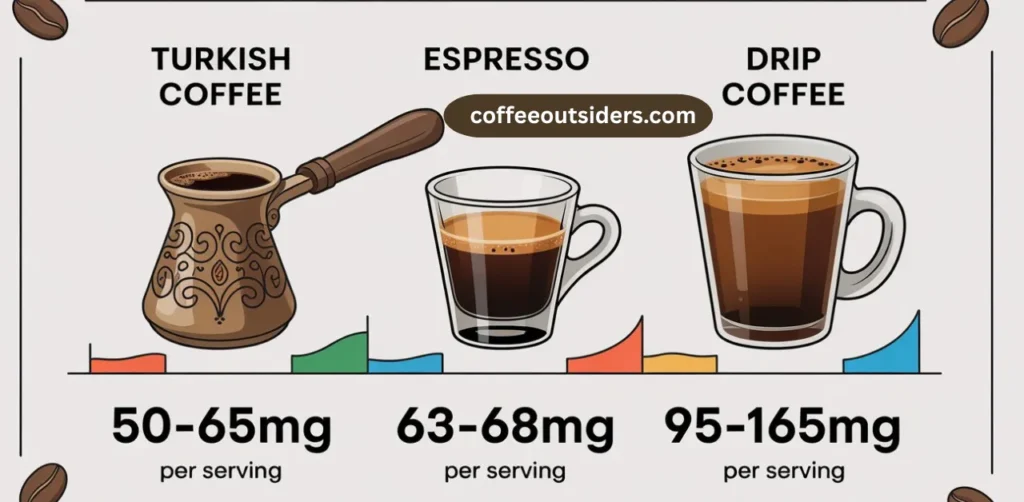
I’ve personally felt a more sustained, gradual buzz from a slow Turkish coffee compared to the sharp spike-and-crash of a quick espresso. Same ballpark of caffeine, completely different feel.
Turkish Coffee vs Drip Coffee
| Factor | Turkish Coffee | Drip Coffee |
|---|---|---|
| Typical serving | 60–70 ml | 240 ml (8 oz) |
| Caffeine per serving | 50–65 mg | 95–200 mg |
| Caffeine per ounce | 25–30 mg | 12–15 mg |
Drip coffee delivers MORE total caffeine per sitting — sometimes 2–3x more. But that’s entirely because the cup is 4x larger. Ounce for ounce, Turkish coffee is twice as concentrated.
If you somehow drank 8 oz of Turkish coffee (please don’t), you’d be looking at 200–240 mg. That rivals the strongest drip coffees.
Turkish Coffee vs Cold Brew
Cold brew extracts caffeine slowly over 12–24 hours, producing 150–200 mg per 12 oz serving. It’s one of the highest-caffeine methods by total volume. But per ounce, cold brew (12–25 mg/oz) is actually comparable to or slightly less concentrated than Turkish coffee (25–30 mg/oz).
Turkish Coffee vs Moka Pot
Moka pot coffee is Turkish coffee’s closest rival in concentration. A 3–4 oz moka pot serving delivers 80–120 mg of caffeine — more per serving than Turkish coffee, and comparable per ounce. The moka pot’s pressurized brewing (1–2 bars) extracts caffeine more efficiently than Turkish coffee’s boiling method.
Turkish Coffee vs French Press
French press coffee uses a coarse grind and 4-minute steep, producing 80–135 mg per 8 oz cup. Per ounce (10–17 mg), it’s significantly less concentrated than Turkish coffee. The coarser grind means less surface area and less efficient caffeine extraction.
Complete Caffeine Comparison Table
| Brewing Method | Serving Size | Caffeine Per Serving | Caffeine Per Oz | Caffeine Per 100ml |
|---|---|---|---|---|
| Turkish Coffee | 2–2.4 oz (60–70 ml) | 50–65 mg | 25–30 mg | 80–110 mg |
| Espresso (single) | 1 oz (30 ml) | 63 mg | 63 mg | 212 mg |
| Espresso (double) | 2 oz (60 ml) | 126 mg | 63 mg | 212 mg |
| Moka Pot | 3–4 oz (90–120 ml) | 80–120 mg | 45–65 mg | 90–130 mg |
| Drip Coffee | 8 oz (240 ml) | 95–200 mg | 12–15 mg | 40–55 mg |
| Pour Over | 8 oz (240 ml) | 80–185 mg | 10–23 mg | 35–75 mg |
| French Press | 8 oz (240 ml) | 80–135 mg | 10–17 mg | 33–55 mg |
| Cold Brew | 12 oz (355 ml) | 150–200 mg | 12–25 mg | 40–65 mg |
| Instant Coffee | 8 oz (240 ml) | 30–90 mg | 4–11 mg | 13–35 mg |
Is Turkish Coffee Strong? Coffee Strength vs Caffeine Content
Yes, Turkish coffee is strong. But “strong” means different things depending on context — and most people confuse taste strength with caffeine strength. They’re not the same thing.
Coffee strength refers to flavor concentration, body, and intensity. It’s about how the coffee tastes and feels in your mouth.
Caffeine content refers to milligrams of caffeine in the drink. It’s about the chemical stimulant effect.
Turkish coffee tastes stronger than drip coffee. Dramatically stronger. But a large drip coffee often contains more total caffeine. A 16-oz Starbucks Pike Place has roughly 310 mg — that’s 5x the caffeine of a Turkish coffee cup. Yet most people would say Turkish coffee “tastes stronger.”
Why Turkish Coffee Feels Stronger Than It Is
Three factors create the perception of extreme strength:
- Ultra-fine grind — the powder-like particles create a thick, dense liquid that coats your mouth. Your brain interprets this thickness as “strong.”
- Unfiltered brewing — micro-particles of coffee remain suspended in the liquid. This adds body and a slightly gritty texture that filtered coffees don’t have.
- High coffee-to-water ratio — more coffee dissolved in less water means a more concentrated flavor per sip.
The result? Turkish coffee feels like the strongest thing you’ve ever tasted, even when a regular drip coffee might contain 2–3x more caffeine per serving. Perception and reality don’t always match.
Why Turkish Coffee Has High Caffeine Concentration
When I brew Turkish coffee, I’m working with a method that maximizes caffeine extraction per milliliter of liquid. Four factors drive this:
1. Ultra-Fine Grind Size
Turkish coffee uses the finest grind in all of coffee — finer than espresso, almost like talcum powder. When I grind coffee this fine, the surface area increases dramatically. More surface area means water contacts more coffee particles simultaneously, and caffeine dissolves faster and more completely.
The difference is significant. A coarse French press grind might expose 50% of the coffee’s internal caffeine to water. Turkish coffee’s powder grind exposes closer to 80–90%.
2. Zero Filtration
Every other brewing method filters something out — paper filters, metal mesh, portafilter baskets. Turkish coffee filters nothing. The grounds pour directly into your cup and stay there.
Because no filter removes oils or microscopic particles:
- More dissolved compounds remain in the liquid
- The body becomes thicker and heavier
- Caffeine stays in the drink instead of being absorbed by paper
- The grounds continue releasing caffeine as you sip
3. High Coffee-to-Water Ratio
I typically use about 7–10 grams of coffee for a 60–70 ml cup. That’s a roughly 1:8 to 1:10 coffee-to-water ratio.
For comparison:
| Method | Coffee-to-Water Ratio |
|---|---|
| Turkish coffee | 1:8 to 1:10 |
| Espresso | 1:2 to 1:3 |
| Moka Pot | 1:7 to 1:10 |
| Drip coffee | 1:15 to 1:18 |
| French Press | 1:12 to 1:17 |
| Cold Brew | 1:5 to 1:8 |
Turkish coffee’s ratio is among the strongest. More coffee per milliliter of water means more caffeine dissolved into a smaller volume.
4. Roast Level Impact
Here’s something most people overlook — roast level affects caffeine, but not the way you’d expect.
Light roasts retain slightly more caffeine per scoop (by volume) because the beans are denser. Dark roasting causes beans to expand and lose mass, so you get fewer beans per scoop.
By weight, the difference is minimal. A gram of light roast and a gram of dark roast contain nearly identical caffeine.
Most traditional Turkish coffee uses a medium to medium-dark roast. If you switch to light roast beans and measure by volume (scoops/teaspoons), you’ll get slightly more caffeine per cup — maybe 5–10 mg more. Not a huge swing, but worth knowing.
☕ Pro Tip: Want maximum caffeine from your Turkish coffee? Use light-roasted Robusta beans, grind as fine as possible, use a heaping measure, and do a slow triple foam. You could hit 90–100 mg per cup.
How Coffee Beans Affect Caffeine in Turkish Coffee
The type of bean you use is the single biggest variable in Turkish coffee caffeine content. Bigger than grind size. Bigger than brewing technique. Bean choice alone can nearly double your caffeine.
Arabica vs Robusta: The Caffeine Gap
| Bean Type | Caffeine by Weight | Caffeine Per Turkish Coffee Cup |
|---|---|---|
| 100% Arabica | 1.0–1.5% | 50–65 mg |
| 100% Robusta | 2.0–2.7% | 85–115 mg |
| 50/50 Blend | 1.5–2.0% | 65–85 mg |
Most traditional Turkish coffee uses 100% Arabica beans — they produce a smoother, more complex flavor with less bitterness. But some commercial blends and certain regional preparations mix in Robusta for a stronger caffeine kick.

If you’re buying pre-ground Turkish coffee from a store, check whether it’s a blend. Some popular brands include Robusta without prominently advertising it. That’s not necessarily bad — it just means your caffeine intake is higher than the standard 50–65 mg estimate.
Bean Origin Matters Too
Even within Arabica, caffeine varies by origin:
- Ethiopian Arabica: Tends toward higher caffeine (1.3–1.5%)
- Colombian Arabica: Mid-range (1.1–1.4%)
- Brazilian Arabica: Often slightly lower (1.0–1.3%)
The difference is modest — maybe 5–10 mg per cup. But if you’re tracking caffeine carefully (pregnancy, medication interactions, caffeine sensitivity), bean origin is worth knowing.
How to Make Turkish Coffee at Home (Complete Guide)
Making Turkish coffee is deceptively simple — five ingredients, one pot, ten minutes. But small technique differences change both flavor and caffeine extraction significantly.
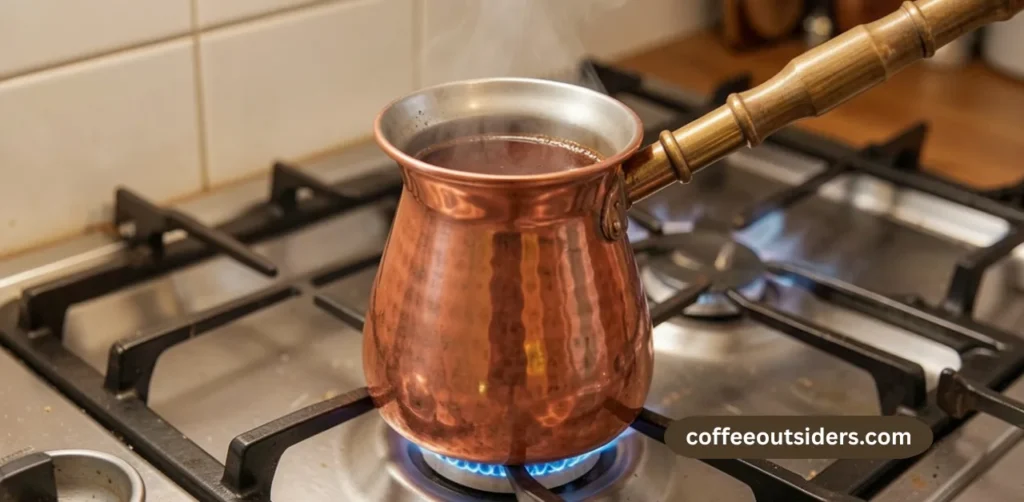
What You Need
- Cezve (ibrik) — small, long-handled brewing pot. Copper or brass traditional; stainless steel works too. The wide bottom and narrow neck are essential for foam formation.
- Turkish-ground coffee — ultra-fine, powder consistency. If you can feel individual particles between your fingers, it’s too coarse.
- Cold filtered water — always start cold. This allows gradual, even extraction.
- Sugar (optional) — must be added during brewing, never after.
- Demitasse cups — traditional small cups, 60–70 ml capacity.
- Cardamom pods (optional) — traditional in Arabic-style preparation. Crack them slightly before adding.
Choosing the Right Cezve
A good cezve makes a real difference:
- Size: Match to your serving. A 1-cup cezve for solo brewing, 3-cup for guests. Too large = poor foam formation.
- Material: Copper heats most evenly. Brass is traditional. Stainless steel is easiest to maintain.
- Shape: Wide bottom for even heating. Narrow neck to trap and build foam. Long handle so you don’t burn yourself.
Step-by-Step Brewing
- Measure cold water using your demitasse cup as a measuring tool — one cup of water per serving
- Add coffee — 1 heaping teaspoon (7–10 g) per cup. Adjust to taste.
- Add sugar now if you want it. Traditional levels:
- Sade — no sugar
- Az şekerli — half teaspoon (lightly sweet)
- Orta — one teaspoon (medium sweet)
- Şekerli — 1.5–2 teaspoons (sweet)
- Stir once gently to combine coffee and water. Just enough to wet all the grounds.
- Place on LOW heat — this is non-negotiable. Low and slow extracts more caffeine and flavor. High heat scorches the coffee and kills the foam.
- Watch carefully. After 2–3 minutes, foam will begin forming. When it rises toward the rim — but BEFORE it boils over — remove from heat.
- Spoon foam into each cup first. The foam (called kaimaki) is the signature of properly made Turkish coffee.
- Return to heat. Let it foam a second time. Some traditionalists repeat this a third time — each cycle extracts slightly more caffeine and deepens the flavor.
- Pour slowly into cups at a low angle, preserving foam on top.
- Wait 1–2 minutes before your first sip. Let the grounds settle to the bottom.
Key Mistakes to Avoid
- Never stir after the initial mix. Stirring after heating destroys the foam.
- Never let it reach a full rolling boil. Gentle foaming, not boiling. Boiling makes it bitter.
- Never add sugar after brewing. Sugar must dissolve during the heating process.
- Never use boiling water to start. Always cold water for proper extraction.
📝 Quick Note: No foam? Three possible causes — heat was too high, grind was too coarse, or you stirred during heating. The grind issue is most common. If you’re grinding at home, go finer than you think you need to.
Health Benefits and Risks of Turkish Coffee Caffeine
Turkish coffee’s 50–65 mg per cup puts it in a moderate caffeine range. According to the FDA, up to 400 mg of caffeine per day is generally safe for healthy adults. That’s roughly 6–8 cups of Turkish coffee — well above what most people drink.
Potential Benefits
Rich in antioxidants. Turkish coffee preserves more chlorogenic acids and polyphenols than paper-filtered methods. The unfiltered brewing keeps beneficial compounds that a paper filter would absorb. A 2017 study in the European Journal of Nutrition found that unfiltered coffee contains up to 30% more antioxidant compounds than filtered versions.
Moderate, sustained energy. Unlike the caffeine spike from a large drip coffee, Turkish coffee’s smaller dose provides a gentler, more sustained lift. I find it keeps me focused for 2–3 hours without the jittery peak that a 200 mg dose sometimes causes.
Metabolism support. Caffeine increases metabolic rate by 3–11%, according to research published in the American Journal of Clinical Nutrition. Even Turkish coffee’s moderate 50–65 mg provides a measurable metabolic boost.
Mental ritual value. The slow preparation — grinding, measuring, watching the foam rise — forces a genuine pause. There’s real mental health value in a daily ritual that demands your attention for 10 minutes. A grab-and-go paper cup doesn’t offer that.
Potential Risks
Cholesterol impact. This is the biggest concern specific to Turkish coffee. Unfiltered coffee contains cafestol and kahweol — two diterpene compounds that can raise LDL cholesterol levels. A meta-analysis in the European Journal of Clinical Nutrition found that unfiltered coffee raised LDL cholesterol by 6–8 mg/dL compared to filtered coffee. This applies equally to Turkish coffee, French press, and Scandinavian boiled coffee.
If your cholesterol is already elevated, talk to your doctor about how much unfiltered coffee is appropriate.
Sleep disruption. Even 50 mg of caffeine consumed 6 hours before bed can reduce total sleep time by over 40 minutes, according to a study in the Journal of Clinical Sleep Medicine. Turkish coffee after 2–3pm is risky if you’re sensitive.
Caffeine sensitivity. Some people metabolize caffeine slowly (genetic CYP1A2 variation). For slow metabolizers, even one cup of Turkish coffee can cause anxiety, rapid heartbeat, or digestive discomfort. Know your tolerance.
Pregnancy considerations. ACOG (American College of Obstetricians and Gynecologists) recommends limiting caffeine to under 200 mg per day during pregnancy. That’s about 3 cups of Turkish coffee maximum — and only if you’re consuming zero other caffeine sources.
How Many Cups of Turkish Coffee Can You Safely Drink Per Day?
Based on the FDA’s 400 mg daily limit and 50–65 mg per cup:
Healthy adults: 5–7 cups per day stays within guidelines.
But guidelines and real life are different things. Caffeine tolerance varies dramatically from person to person — genetics, body weight, medication interactions, and habitual consumption all play roles.
Here’s a practical framework I use:
- New to Turkish coffee? Start with 1–2 cups. See how you feel.
- Regular coffee drinker? 3–4 cups is a comfortable daily range.
- Space them out. Don’t drink 3 cups in one hour. Spread across the morning.
- Hard cutoff by 2pm. Caffeine’s half-life is 5–6 hours. Afternoon Turkish coffee can haunt you at midnight.
- Count EVERYTHING. Tea, chocolate, energy drinks, cola, pre-workout supplements — all contribute to your daily total.
- Listen to your body. Headache, jitters, racing heart, or stomach discomfort? Cut back by one cup.
Personally, I drink 2 cups before noon. That puts me at roughly 120 mg — plenty to feel sharp and focused without an afternoon crash. A third cup after lunch pushes me into “staring at the ceiling at 1am” territory, so I’ve learned my limit.
Cultural Context: The History of Turkish Coffee
Understanding Turkish coffee means understanding its history — because the brewing method, serving size, and preparation ritual all grew out of centuries of cultural tradition.
Ottoman Coffee Culture
Turkish coffee traces back to the mid-16th century Ottoman Empire. Coffee beans arrived from Yemen, and the Ottomans developed the cezve brewing method that’s still used today — virtually unchanged after 500 years.
Coffeehouses (kahvehane) became central to Ottoman social life. They were gathering places for conversation, poetry, music, and political discussion. The Ottoman court had an official kahvecibaşı (chief coffee maker) — a position that carried real political influence.
UNESCO Recognition
In 2013, UNESCO inscribed Turkish coffee culture on its Representative List of Intangible Cultural Heritage of Humanity. The recognition wasn’t about the drink itself — it was about the entire tradition: the preparation ritual, the serving customs, the social bonding, and the fortune-telling from the grounds.
Traditional Serving and Fortune Reading
Turkish coffee is traditionally served with a glass of water (to cleanse the palate) and a small sweet — often Turkish delight (lokum). The water is sipped first, then the coffee.

After finishing, many people flip their cup upside down on the saucer and wait for the grounds to dry. The patterns left inside the cup are then “read” — a tradition called tasseography or fal. It’s part social entertainment, part superstition, and entirely woven into the coffee experience.
The small cup wasn’t a random choice. It was deliberately sized for a concentrated, communal ritual — quality over quantity. One small cup, shared slowly, meant more than a large mug consumed in isolation. That philosophy is 500 years old, and it still holds.
Conclusion:
Turkish coffee delivers 50–65 mg of caffeine in just 2 ounces — concentrated, bold, and backed by over 500 years of tradition. Ounce for ounce, it hits harder than most brewing methods, even if the tiny serving size keeps the total caffeine moderate. Two to three cups a day sits comfortably within safe limits for most people. Grab a cezve, grind your beans to powder, and give the oldest brewing method in the world a proper try. The 10-minute ritual alone is worth it.

Zaibi
Zaibi blends compelling storytelling with strong digital expertise at Coffee Outsiders. With a background in SEO and content strategy, he ensures articles about coffee beans, brewing, tea, and drinks are both engaging and easy to discover online.
Frequently Asked Questions
A standard 2–2.4 oz (60–70 ml) Turkish coffee contains approximately 50–65 mg of caffeine. Per ounce, that’s about 25–30 mg — more concentrated than drip coffee but less than espresso.
Per ounce, espresso contains more caffeine (~63 mg/oz vs ~25–30 mg/oz). Per serving, they’re very close — a single espresso has ~63 mg, a Turkish coffee has 50–65 mg. However, Turkish coffee delivers a more intense flavor experience because it’s completely unfiltered.
By concentration per ounce, no — espresso and moka pot rank higher. By total caffeine per serving, no — drip coffee and cold brew deliver more. By flavor intensity and body, Turkish coffee is arguably the strongest. “Strongest” depends entirely on what you’re measuring.
Three factors: the ultra-fine powder-like grind creates a thick liquid, the unfiltered brewing leaves micro-particles suspended in every sip, and the high coffee-to-water ratio concentrates flavor. Your brain interprets this dense, heavy body as “strong” even when total caffeine is moderate.
Yes, slightly. The grounds settled at the bottom of your cup continue releasing small amounts of caffeine. Drinking all the way to the bottom adds roughly 5–10 mg compared to stopping early. Most traditional drinkers leave the last sip — for taste reasons and for fortune reading.
At 50–65 mg per cup, 2–3 daily cups put you at 100–195 mg — well within the FDA’s 400 mg daily guideline. The main long-term consideration is the cholesterol impact of unfiltered coffee. If your LDL is already elevated, discuss with your doctor.
One standard 8-oz drip coffee (95–200 mg) equals approximately 2–3 cups of Turkish coffee in total caffeine. But the experience is completely different — concentrated sipping vs casual drinking.
Zero difference. Sugar affects taste only. Whether you drink it sade (plain), orta (medium sweet), or şekerli (sweet), caffeine content remains identical.
Caffeine increases metabolic rate by 3–11% and can enhance fat oxidation during exercise. Turkish coffee’s moderate 50–65 mg dose provides this benefit. However, adding sugar increases calories. For weight management, drink it sade (without sugar).
The brewing method is nearly identical — ultra-fine grind, cezve/ibrik, no filtration. The main difference is flavor additions. Arabic coffee typically includes cardamom (and sometimes saffron or cloves), while traditional Turkish coffee is either plain or with sugar only. Caffeine content is essentially the same.